
German Board Certified FIFA Diploma DKG AGA GOTS
Riyadh, Saudi Arabia
Dr. Yousef Muhammad — Orthopaedic SurgeonPhone +966 11 522 2222
Shoulder Condition

Frozen Shoulder

Symptoms, Diagnosis & Treatment Options

Frozen shoulder is a painful, progressive stiffening of the joint that develops in stages — and, in time, usually resolves. Understanding its phases is the key to managing it well.

Dr. Yousef Muhammad
Dr. Yousef Muhammad
German Board Certified Orthopaedic Surgeon | Sports Medicine | Arthroscopy | Joint Replacement
  • German Board-Certified Orthopaedic Surgeon
  • DKG Certified Knee Surgeon
  • AGA Certified Arthroscopic Surgeon
  • GOTS Certified Sports Physician
  • FIFA Diploma in Football Medicine
  • International Experience (Germany & Middle East)
  • Former Chief of Orthopaedic Surgery (Germany)
  • 14+ Years of Experience

Frozen shoulder (adhesive capsulitis) is a condition in which the capsule surrounding the shoulder joint becomes inflamed, thickened and tight. As it contracts, the shoulder becomes progressively stiff and painful, limiting movement in every direction.
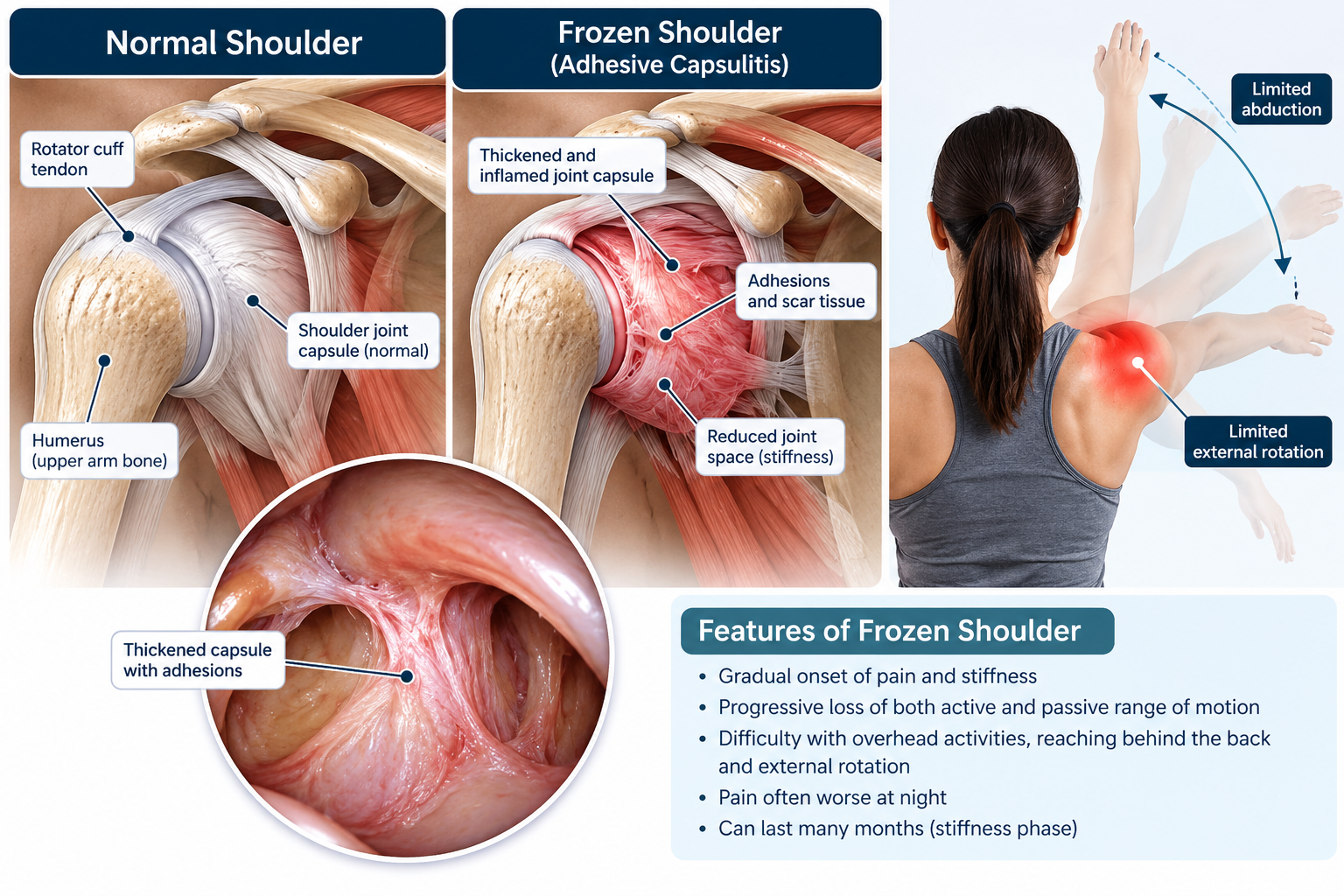
Anatomy diagram

1. Anatomy & Overview

Frozen shoulder (adhesive capsulitis) is a condition in which the capsule surrounding the shoulder joint becomes inflamed, thickened and tight.

Clinical examination

2. Signs & Symptoms

Progressive stiffness — limiting movement in all directions.
Diagnostic imaging

3. Diagnosis & Imaging

Frozen shoulder is largely a clinical diagnosis — the hallmark is loss of both active and passive movement, which distinguishes it from a cuff tear.

Treatment

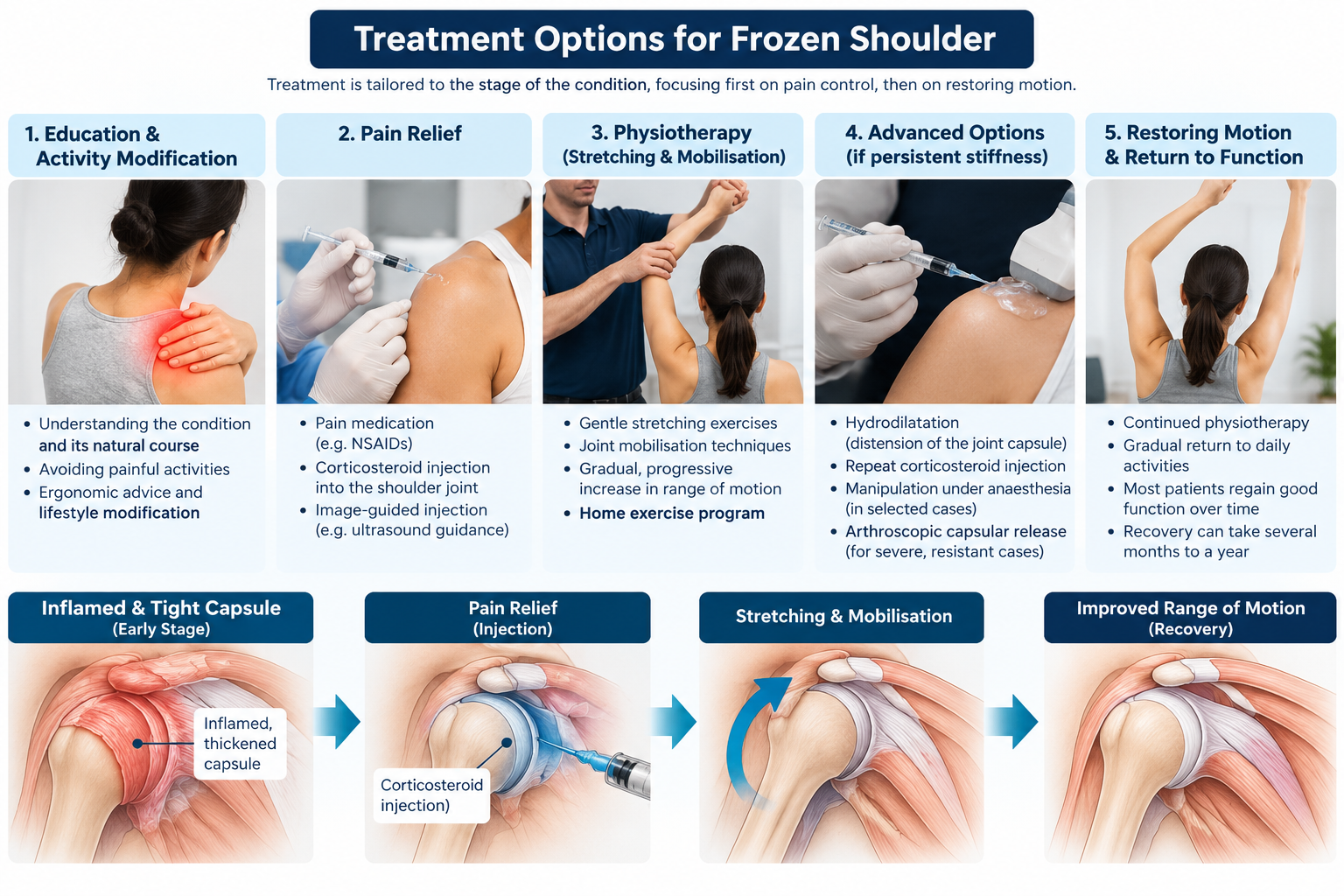
4. Treatment Options

Treatment is matched to the phase, focusing first on controlling pain, then on restoring motion.
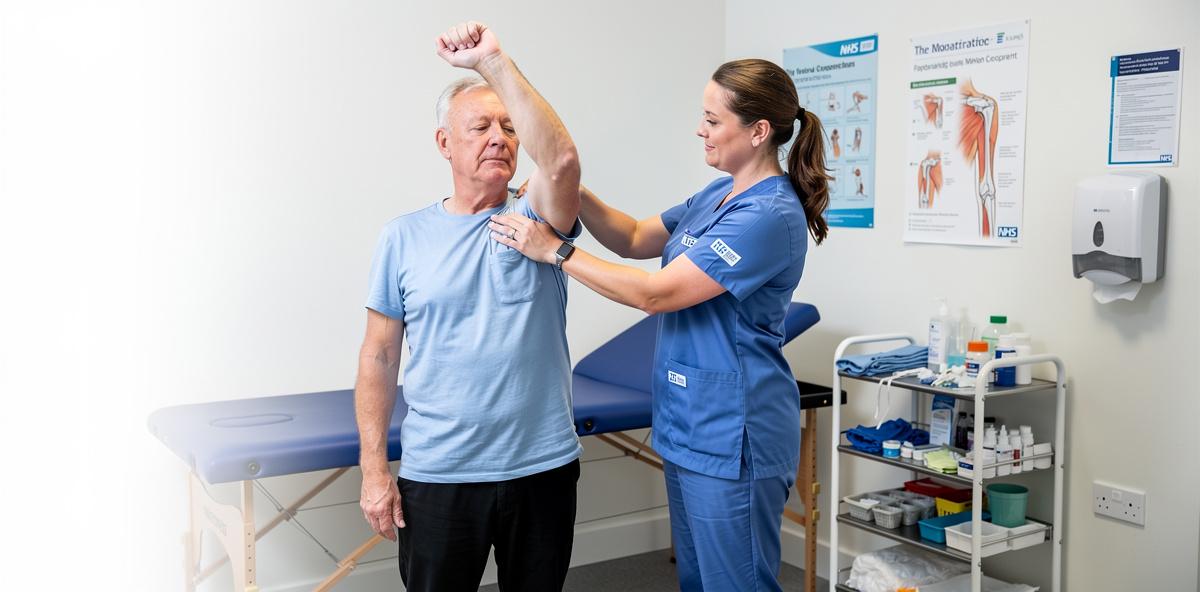
Rehabilitation

5. Recovery & Rehabilitation

The reassuring message is that frozen shoulder almost always improves, with most patients regaining good, functional movement.

Dr. Yousef Muhammad
Clinical Note from Dr. Yousef Muhammad

Frozen shoulder is a painful, progressive stiffening of the joint that develops in stages — and, in time, usually resolves. Understanding its phases is the key to managing it well.

Dr. Yousef Muhammad
Dr. Yousef Muhammad
Consultant Orthopaedic Surgeon

Frequently Asked Questions

What are the phases of Frozen Shoulder?
Freezing — Increasing pain, often worse at night, with movement gradually becoming more limited. Lasts roughly 2–9 months. Frozen — Pain may ease, but stiffness is marked and daily tasks are restricted. Lasts roughly 4–12 months. Thawing — Movement slowly and steadily improves, often back to near-normal over the following months.
What are the symptoms of Frozen Shoulder?
Progressive stiffness — limiting movement in all directions. A deep, aching pain — often worse at night and on sudden movement. Difficulty with everyday tasks — reaching overhead, dressing, fastening a seatbelt. A loss of both active and passive motion — even when someone else moves the arm.
How is Frozen Shoulder diagnosed?
Frozen shoulder is largely a clinical diagnosis — the hallmark is loss of both active and passive movement, which distinguishes it from a cuff tear. Imaging such as X-ray or MRI is mainly used to exclude other causes of a stiff, painful shoulder.
How is Frozen Shoulder treated?
Treatment is matched to the phase, focusing first on controlling pain, then on restoring motion. Physiotherapy: Gentle, progressive stretching maintains and then restores range of motion as pain allows. Pain control & injection: Anti-inflammatories and a well-timed injection can settle the painful phase and unlock progress. Release procedures: For stubborn cases, manipulation under anaesthetic or an arthroscopic capsular release restores movement.
What does recovery involve?
The reassuring message is that frozen shoulder almost always improves, with most patients regaining good, functional movement. The course can be long — sometimes a couple of years — but a clear, phase-based plan eases symptoms and can meaningfully shorten the journey.

Note: This information is for general education only and should not replace a consultation with your doctor.

International Medical References

Related Conditions

Book an Appointment

Secure your consultation today.

Book Appointment

WhatsApp Us

Quick response for your enquiries.

Chat on WhatsApp